
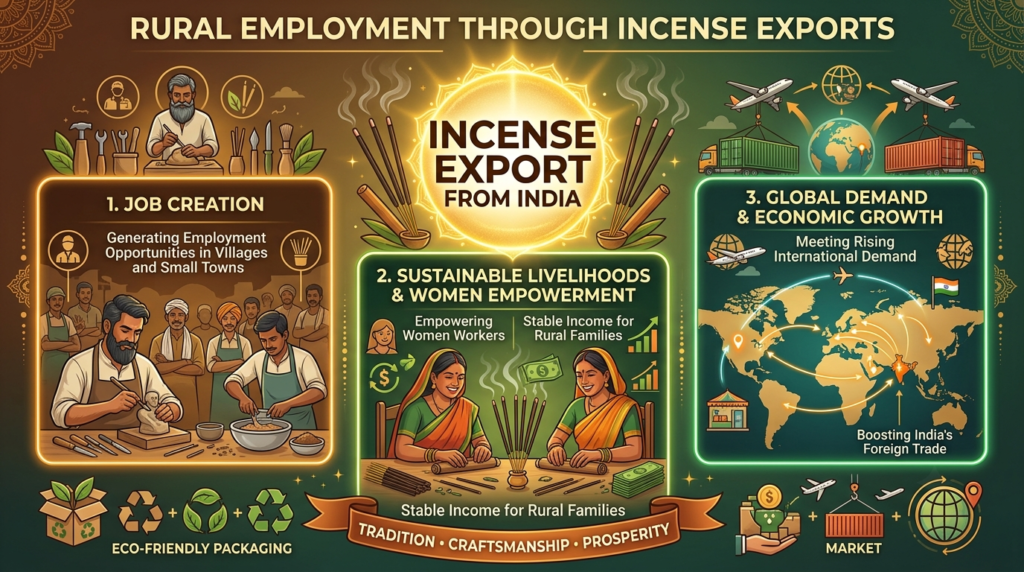
Walk into almost any Indian home, temple, or roadside shop. You’ll catch that familiar curl of fragrant smoke. Agarbatti is no longer just a household ritual. It has become a genuine export success story. In fact, agarbatti export India rural employment is one of those rare economic threads that ties spirituality, small-scale manufacturing, and global trade together. As a result, it is quietly transforming livelihoods in villages far from India’s big cities.
The domestic incense sticks (agarbatti & dhoop) market was valued at roughly USD 1.3 billion in 2025. Industry estimates place the broader sector at ₹10,000–12,000 crore annually. So agarbatti has grown from a cottage craft into a serious economic engine. Notably, this engine runs almost entirely on rural hands.
India’s Position as a Global Incense Exporter
India isn’t just the world’s largest consumer of incense sticks. It also ranks among the top three exporters globally, alongside China and the UAE (Ministry of Commerce trade data). In a recent year, India shipped agarbatti worth roughly $146 million. These exports reached customers in over 150 countries, from the United States and the Gulf to Southeast Asia and Latin America.
Karnataka alone accounts for close to a third of national production. Meanwhile, South India as a whole holds nearly half the domestic market share, largely due to its manufacturing density and proximity to raw materials. This export strength explains why agarbatti export India rural employment has become such an important talking point among policymakers and trade bodies. After all, every shipment leaving Indian ports represents wages earned by thousands of home-based and cottage-industry workers.
Agarbatti Export India Rural Employment: Jobs for Women and Cottage Workers
This is where the real story lives. Agarbatti-making is overwhelmingly a hand-based, decentralized craft. Rolling sticks, mixing masala paste, drying, and packaging are tasks that women largely perform from home or in small village units.
- India’s incense stick industry supports more than 4 lakh (400,000) workers nationwide.
- Roughly 80% of these workers are women. Many work flexible, home-based hours that fit around family responsibilities.
- Production requires minimal machinery, so entry barriers stay low. A woman with basic training can start earning within days.
- Businesses often pay workers on a job-work or piece-rate basis. This gives rural households a reliable secondary income stream.
This is the heart of agarbatti export India rural employment. Unlike many export industries, this one creates truly accessible jobs in places where formal employment options are otherwise scarce. For many rural women, hand-rolling incense sticks becomes their first entry point into independent income and financial participation.
Major Production Hubs: Karnataka, Mysore, and Bangalore
Karnataka is, without question, the beating heart of India’s agarbatti industry. Specifically, Bangalore and Mysore have built decades of manufacturing expertise, supply-chain infrastructure, and skilled artisan networks around incense production.
- Mysore is often called the historic capital of India’s agarbatti trade. It’s known for high-quality, masala-based, hand-rolled sticks.
- Bangalore hosts several major exporters and manufacturing units. These businesses benefit from strong logistics links to ports and international buyers.
- Beyond Karnataka, states like Gujarat, Madhya Pradesh, Uttar Pradesh, and Andhra Pradesh contribute meaningfully. Growing cottage clusters in the Northeast add further capacity, since bamboo — a key raw material — grows abundantly there.
These hubs don’t just produce incense. They anchor entire local economies, from bamboo stick suppliers to fragrance oil blenders to packaging units. Consequently, they multiply the employment impact far beyond the rolling process itself.
Government Initiatives and BIS Quality Standards Boosting Agarbatti Export India Rural Employment
The Indian government recognizes the sector’s rural employment potential. Therefore, it has taken deliberate steps to strengthen the industry:
- Khadi Agarbatti Aatmanirbhar Mission (KAAM), launched by the Khadi and Village Industries Commission (KVIC), supplies automatic agarbatti-making and powder-mixing machines to artisans. Private manufacturers partner in this effort, and each machine set creates direct employment for several workers.
- The government restricted raw agarbatti imports and raised import duty on bamboo sticks. These moves specifically aim to boost domestic, rural-based production instead of relying on cheaper imports.
- The SFURTI scheme has funded agarbatti clusters with proper marketing linkages. So far, it has benefited thousands of additional artisans.
- New BIS (Bureau of Indian Standards) quality benchmarks for agarbatti are improving product safety and consistency. In turn, this builds the trust international buyers need to place larger, recurring export orders.
Together, these initiatives keep the value chain — and the jobs it creates — firmly rooted in rural India rather than shifting overseas.
Future Growth Potential and Challenges
The outlook remains strong. India’s incense sticks market is projected to nearly double by the early 2030s. Rising global interest in natural, aromatherapy-oriented, and charcoal-free incense plays directly to India’s traditional strengths in hand-rolled, masala-based products.
That said, challenges remain:
- Fragmentation — small, unorganized players still dominate the industry, which makes quality consistency and scale harder to achieve.
- Raw material supply — reliable, sustainable bamboo sourcing needs continued investment.
- Competition — China and Vietnam remain aggressive competitors in machine-made segments. So India must lean further into its handmade, artisanal differentiation.
- Wage security — ensuring fair, consistent piece-rate wages for home-based workers remains an ongoing policy priority.
Addressing these gaps will determine how much further agarbatti export India rural employment can scale over the coming decade.
Conclusion: Agarbatti Export India Rural Employment Lifts Rural Economies
Behind every stick of incense exported from India stands a rural worker — often a woman — whose livelihood depends on this quietly powerful industry. What began as a cultural and spiritual craft has evolved into a genuine socio-economic lifeline. It now supports hundreds of thousands of households and anchors regional hubs like Karnataka, Mysore, and Bangalore. As a result, India has earned a respected place in the global incense trade. Government schemes continue to strengthen quality standards and production capacity. So agarbatti exports are set to do more than perfume homes abroad — they’ll keep lifting rural economies at home, one hand-rolled stick at a time.