
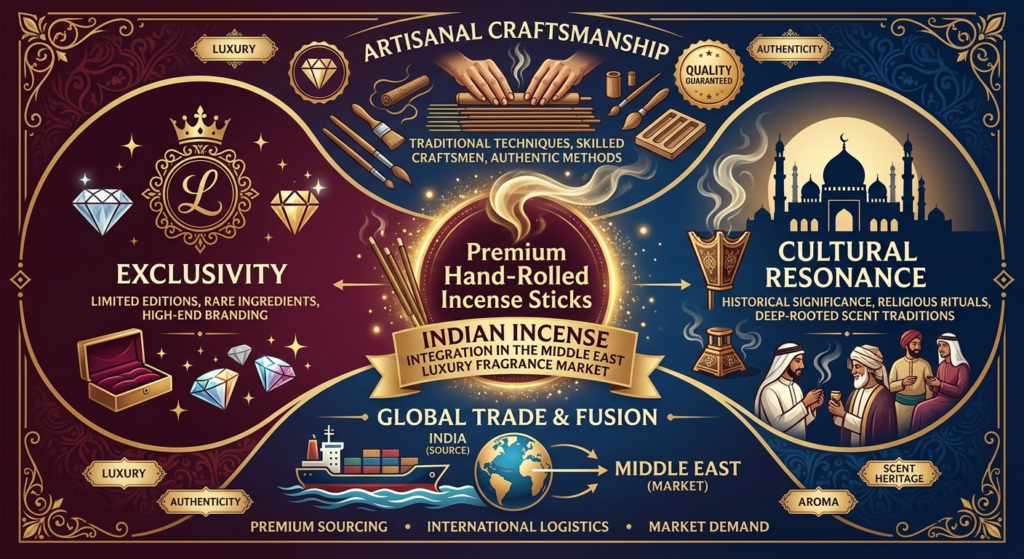
Premium Hand-Rolled Incense Sticks are opening a strong opportunity for importers targeting the Middle East luxury fragrance market. After all, this region already places fragrance at the center of daily life, home hospitality, and personal identity. Because of that, imported incense needs to meet a high bar for quality and exclusivity. To understand why, it helps to first look at the region’s fragrance heritage.
The Heritage of Fragrance in Middle Eastern Culture
Fragrance holds deep cultural weight across the Middle East. For instance, oud, one of the world’s most prized aromatic woods, has anchored the region’s scent traditions for centuries. Similarly, bakhoor, a fragrant wood chip blend burned in homes and gatherings, remains a daily ritual in many households. In addition, incense plays a role in mosques, where its scent accompanies prayer and reflection.
Because fragrance carries such strong cultural and spiritual meaning, luxury positioning comes naturally here. As a result, Middle Eastern consumers don’t just buy scent. Instead, they buy heritage, status, and hospitality, all wrapped into a single product.
Why Premium Hand-Rolled Incense Sticks Fit Middle Eastern Values
Premium Hand-Rolled Incense Sticks from India align closely with what Middle Eastern buyers already value:
- Exclusivity. Because artisans can only roll so many sticks by hand each day, production stays limited. Consequently, this scarcity supports premium pricing and luxury appeal.
- Authenticity. Buyers can sense genuine craftsmanship. Indeed, hand-rolled incense, made from real resins and botanicals, carries a story that machine-made products cannot match.
- Luxury positioning. Likewise, skilled artisan production pairs naturally with the region’s existing appetite for high-end oud and bakhoor products.
Together, these qualities let Indian incense sit comfortably alongside established Middle Eastern luxury fragrance categories.
Buyer Psychology: Artisanal, Eco-Friendly, and Fragrance-Specific Preferences
Middle Eastern consumers increasingly favor artisanal and eco-friendly products across many categories, not just fragrance. In fact, this mirrors a broader global shift. According to research from the Global Wellness Institute, consumers worldwide continue placing greater value on natural ingredients and transparent sourcing, a pattern increasingly visible in Gulf luxury markets as well.
Generally, fragrance preference tends to split into two main categories. On one hand, woody blends, especially sandalwood, complement the region’s existing love of oud and heavier resinous scents. On the other hand, floral notes, including rose and jasmine, appeal to buyers seeking lighter, everyday luxury fragrance for home use.
Overall, buyers in this market respond strongly to exclusivity. Specifically, limited-batch production, premium packaging, and a clear artisan story all reinforce the sense that a product is worth a higher price point.
A Guide for Importers: Certifications, Logistics, and Packaging
Successfully importing incense into Middle Eastern markets requires attention to several key areas.
Certifications
First, confirm that your supplier can provide organic or natural ingredient certification where available. Additionally, Gulf countries increasingly enforce import standards around product safety and labeling, so request full ingredient documentation before finalizing any order.
Logistics
Next, because incense is lightweight but fragile, packaging quality affects both shipping cost and product condition. Therefore, work with freight forwarders experienced in India-to-Gulf trade routes. This helps you navigate customs requirements smoothly and avoid unnecessary delays.
Packaging and Positioning
Finally, luxury positioning starts with packaging. Since buyers in this market expect premium presentation, consider elegant boxing, natural materials, and branding that reflects craftsmanship rather than mass production. Moreover, position the product alongside oud and bakhoor rather than budget incense categories, since this framing supports stronger margins and better retail placement.
Hand-Rolled vs. Machine-Made: Why Craftsmanship Wins Here
Machine-made incense relies on synthetic fragrance oils and high-speed production. While this keeps costs low, it also strips away the exclusivity that luxury buyers actively seek.
By contrast, hand-rolled incense takes the opposite approach. Artisans shape each stick individually, which limits output and increases perceived value. Additionally, this process allows for richer, more complex scent layering than automated methods can achieve. For a market built on prestige and heritage, that distinction matters enormously. Ultimately, buyers who already invest in premium oud recognize genuine craftsmanship quickly, and they reward it with loyalty and repeat purchases.
Partner with a Trusted Supplier
In short, the Middle East luxury fragrance market offers real opportunity for importers who understand its values: exclusivity, authenticity, and deep-rooted heritage. Premium Hand-Rolled Incense Sticks meet these expectations through limited-batch artisan production and genuine natural ingredients, positioning them well alongside the region’s most trusted fragrance categories.
To that end, Heaven’s Aroma offers exactly this combination of craftsmanship and consistency. Explore Heaven’s Aroma’s Premium Hand-Rolled Incense Sticks to source authentic, luxury-grade incense tailored for the Middle East fragrance market, and build a supply partnership rooted in quality and trust.